
Editorial
Women for women towards peaceful General-Elections
WSR is a non-partisan and neutral process at all times. It mobilizes women in collaboration with youth to ensure their active participation in peaceful electoral processes. It gets its mandate from the UN Security Council Resolution (UNSCR) 1325 and the Gender is My Agenda Campaign (GIMAC) of the African Union, which affirm the role of women in the peace process and peace-building in their countries.

When we reached out to Pamela Akoth for an interview, she was in her garden. This is an economic activity she has embraced for the last couple of years. The single mother of one previously worked in a flower garden in Naivasha but went back to her home in Homabay county following the 2007 post-election violence.
“Around 3 in the afternoon, an announcement was made in the flower farm that things were not good. We were then asked to go back home. There were no vehicles on the road so we trekked in bushes,” the 45 years old lady recalls.
Thoughts of rape crossed her and she was scared. At this point, getting her teenage daughter to safety became priority. Being a weekend, her daughter who was in form two was at home. Pamela was lucky to find her daughter safe in their rental house. Unfortunately, they were no longer safe in their home and they fled with nothing but the clothes they were wearing.
“When we were running police officers were around but they were helpless. If there was a specific office where one could report, it would have been better,” she narrates her ordeal.
Before she moved to her native home in Homabay, she got temporary shelter for Internally Displaced Persons (IDPs) at Longonot centre in Naivasha, among other people who were affected by the violence.
Almost 15 years down the line, Pamela bemoans the fact that she never received any compensation despite making a report to the police and being in possession of documents that prove she was a victim of the post-election violence. Nevertheless, she is grateful that she and her daughter are alive.
The scenes from the violence are still etched in Pamela’s mind and her only desire is that the government protects women due to their vulnerability as the 9th August 2022 general election approaches.
“If there are people who can stand firm and guard women then let them be dedicated so that women can contact them just in case things don’t go well for them,” she says. Vulnerable women can report for help, she says in an exclusive interview noting, “I think this can save the lives of some people.”.
Same script, different victim
Like Pamela, Beatrice Waithera witnessed the effects of the 2007 post-election violence albeit slightly different. Waithera, a women rights journalist and activist was then a form one student. She was living in an informal settlement in Nairobi that also a recorded loss of lives and injuries due to election-related violence.
“One particular morning as I was leaving the gate for the shop I remember there was a person who had been assulted and was bleeding. It was just a few yards from where we lived in Kayole,” she recalls.
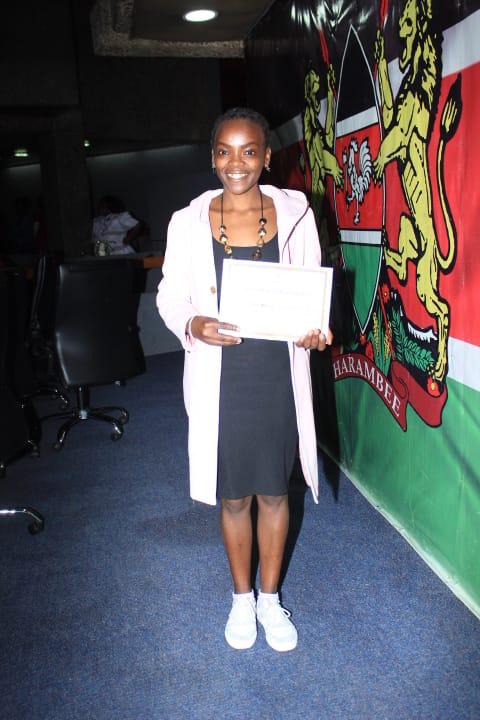
Beatrice Waithera. Photo||Courtesy
Waithera urges Kenyans to maintain peace so that such incidences don’t happen ever again in the country adding that there is need to respect cultural diversity, human dignity, and commitment to maintain peace during this election period. She further notes that Kenyans are already struggling to put food on their tables due to the increased cost of living and the absence of peace would only make the situation worse.
“Violence scares away investors. It makes people go hungry because they cannot afford food and their security is not guaranteed,” says the non-violent peace trainer.
Waithera was recently awarded by the National Women for Peace Convention Caucus as a national peace champion. She is currently conducting civic education, where she holds safe spaces with the youth at the grassroots levels. The participants are empowered with knowledge of good governance and their involvement in decision-making tables. Besides, they also discuss the setbacks that are pulling them back in the community.
Waithera says that for the last two years, these sessions have given the youths a gratifying space. Discussions about peace as an integral part of safeguarding women and youths’ rights are the main areas of her focus.
“As young people, we are learning a lot from the past generation. It is time that Kenyan youths remain vigilant and guard their country and by all means, refuse to be used as tools to spread violence in Kenya,” she told Parents magazine.
Just like Pamela, Waithera also says that if there was a hotline or a signal call that people could use then to report when they sensed looming tension, more lives could have been saved.
The Women Situation Room to the rescue
It is the challenges that people like Pamela and Waithera experienced in the 2007 post-election violence that have prompted the Inter-Religious Council of Kenya (IRCK) to establish a team of eminent women to preach the gospel of peace. The team will operate under a program known as Women Situation Room (WSR), a women’s peace-building mechanism to mitigate conflict before, during, and after elections in African countries.
Dr Grace Ongile, the adviser for the implementation of the women leaders’ involvement in peace, says gender monitors for peace have also been trained across respective counties in Kenya. They will be at different polling stations on the election day and will use a tool known as incidence form, to record cases of violence targeted at women.
“This form will help capture what is not going right for women as voters and aspirants. The person in charge should record and convey that message to us.” Dr Ongile told Parents magazine.
She describes WSR as a useful platform that gives women space to talk. Part of the gender monitors for peace is the police officers. Dr. Ongile, says this will see perpetrators of violence get arrested. She adds that the eminent team will also ensure that women get help in situations where they will need to be taken to hospitals.
“Women’s role in society is extremely important and when there is war, there are many issues that come with it. With this program in mind, we are going to see how best to capture and amplify the voices of women during the elections,” says Dr Ongile.
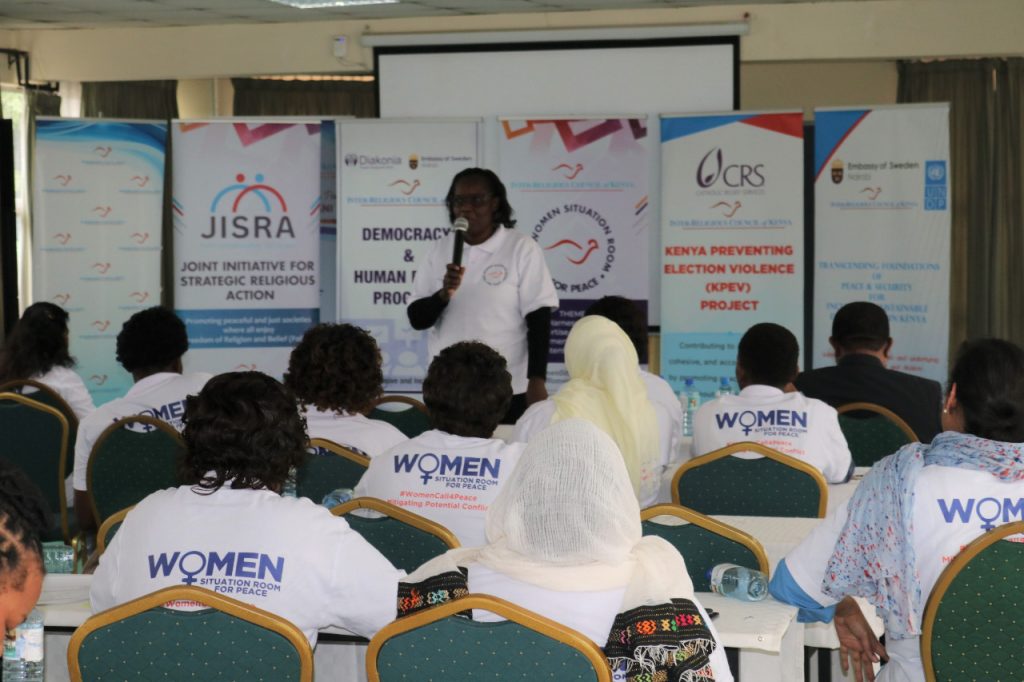
Irene Kizito, Deputy Executive Director, IRCK addressing the Women Gender Monitors during a training. Photo by Mary Ndulili.
Deputy Executive Director, of the Inter-Religious Council of Kenya, Irene Kizito says WSR is very critical in this General-Elections because women’s issues are very different from those of the general public. She says the council would like women to take an active role in the early response and rolling of any issues that may jeopardize peace in the communities.
“I believe that in the past we were caught unaware because many women did not think they could play a role in mitigating some of the things that happened. We are now taking leadership and also training other women to take leadership and manage situations from wherever they are,” she says with optimism adding, “the program is about securing peaceful elections because women do not want their children and community to suffer,”
WSR, was first used in Liberia in the 2011 General Elections before it was replicated in Senegal and Sierra Leon respectively in 2012. Kenya replicated it in the 2013 and 2017 General Elections. The Kenya National Peace and Security chair under the ministry of interior and public service and gender, Shamsha Abubakar, says a lot has been done to make the program more effective in the country. This includes the introduction of, the KoboCollect Application that will be used to collect information in the field before submitting to the eminent team in the WSR.
“This KoboCollect tool gives us options to report the perpetrators, type, and extent of harm done to the woman, whether the woman is a candidate, a voter or a standby woman, he explains. “It also gives us the option to indicate where the incident took place, the County, time, the witnesses identity and telephone numbers,” says Abubakar, — “describing the process as a dream come true.
Other countries that have also replicated the WSR are Nigeria in 2015, and Uganda and Ghana both in 2016. Despite the program having been applied in Kenya during the two previous General Elections, Abubakar says women who were assigned then did not have enough skills. This made it hard for them to report appropriately.
“This toolkit will be a matrix for us to know how many cases have been reported,” she says.
WSR is a non-partisan and neutral process at all times. It mobilizes women in collaboration with youth to ensure their active participation in peaceful electoral processes. It gets its mandate from the UN Security Council Resolution (UNSCR) 1325 and the Gender is My Agenda Campaign (GIMAC) of the African Union, which affirm the role of women in the peace process and peace-building in their countries.
Featured Photo: Women Gender Monitors during a training. Photo by Mary Ndulili.
Get the Mental Health Issue of Parents Magazine HERE

Hello world!
Teen, 17, Fatally Stabbed During Altercation with Friends in Eastleigh
Teen, 17, Fatally Stabbed During Altercation with Friends in Eastleigh
-

 Fashion9 years ago
These ’90s fashion trends are making a comeback in 2017
-
Entertainment9 years ago
The final 6 ‘Game of Thrones’ episodes might feel like a full season
-
Fashion9 years ago
According to Dior Couture, this taboo fashion accessory is back
-
Sports9 years ago
Phillies’ Aaron Altherr makes mind-boggling barehanded play
-
Entertainment9 years ago
The old and New Edition cast comes together to perform
-
Entertainment9 years ago
Disney’s live-action Aladdin finally finds its stars
-
Business9 years ago
Uber and Lyft are finally available in all of New York State
-
Sports9 years ago
Steph Curry finally got the contract he deserves from the Warriors