Connect with us

Cover Story

Hidden costs of parental favoritism

Published

on

Imagine growing up in a household where your other sibling is treated as the golden child. Every achievement the make is celebrated, while your own successes are met with a simple nod or a passing comment.

Family gatherings revolve around their latest accomplishments, and you can’t help but feel like you’re always in their shadow. This is the reality for many children who experience parental favoritism, a quiet but powerful force that can strain relationships and leave lasting emotional scars.

While every parent strives to love their children equally, the truth is, the perception of favoritism can creep in, sometimes unnoticed, subtly affecting the family’s harmony.

Understanding Favoritism

Parental favoritism occurs when one child is consistently favored over others, whether in the form of more attention, affection, or leniency.

While it’s natural for parents to connect differently with each child based on personalities, interests, or needs, problems arise when this connection is perceived as preferential treatment.

Children are incredibly perceptive. Even slight differences in how they are treated compared to their siblings can lead to feelings of resentment, inadequacy, or rivalry. And it’s not just the overlooked child who suffers—the favored one often carries the weight of unrealistic expectations and guilt.

Why Does Favoritism Happen?

Favoritism isn’t always intentional. Sometimes, it’s born out of circumstances—perhaps one child requires more attention due to special needs, or a parent shares more interests with one child than the others.

Stress and external pressures can also cause a parent to unconsciously lean more towards one child for comfort or ease.
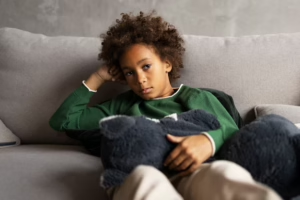
However, these actions can create a ripple effect in the family. The child who feels less favored may withdraw, act out, or develop a strained relationship with their sibling or parent.

The long-term impact can be profound, leading to strained sibling relationships, mental health problems. This would consequently affect the child’s self-esteem and future interpersonal relationships.

The Subtle Signs of Favoritism

Favoritism isn’t always blatant. It can manifest in subtle ways, like giving one child more praise, being more lenient with one’s mistakes, or consistently spending more time with one child over the others. Parents may not even realize they’re doing it, which is why self-awareness is key.

Are you more patient with one child?

Do you find yourself often defending the actions of one child over the others?

Are there different expectations for each child in terms of behavior or achievements?

These questions can help parents reflect on their actions and address any unintentional favoritism.

Mitigating the Impact

The first step in addressing favoritism is acknowledging its existence. It’s essential for parents to reflect on their behavior and consider how each child might perceive it.
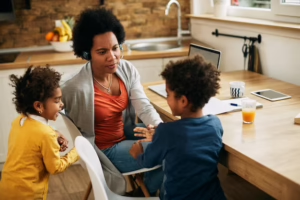
Open communication is crucial—talk to your children about their feelings and listen to their concerns without judgment.

Creating equal opportunities for each child to spend quality time with you can help balance relationships. Ensure that your praise, discipline, and expectations are consistent, adjusting for each child’s individual needs without creating a sense of favoritism.

Encourage sibling bonding by promoting activities that involve all your children, fostering an environment where they can support and appreciate each other.

This not only strengthens their relationship but also minimizes the chances of sibling rivalry fueled by perceived favoritism.

The Road to Balanced Parenting

Parenting is a challenging journey, full of joys and trials. The goal isn’t perfection but awareness and intentionality in how we nurture our children.

By being mindful of our actions and their impact on each child, we can foster a loving, balanced environment where every child feels equally valued and cherished.

In the end, it’s about ensuring that each child knows they are loved uniquely, not more or less than their siblings, but in a way that is special to them.

When children feel secure in their parents’ love, the bonds within the family grow stronger, paving the way for a harmonious and supportive home.

Continue Reading
Click to comment

Leave a Reply

Your email address will not be published. Required fields are marked *

Cover Story

Heartbreak as Body of 12-Year-Old Blessed Claire Muthoni Arrives Home from India

Published

on

Kenyans are mourning the loss of Blessed Claire Muthoni, a brave 12-year-old girl from Kihuri in Othaya, Nyeri County, who passed away while undergoing specialised cancer treatment in New Delhi. Claire had been fighting stage 4 cancer for over three years.

The aggressive disease took a heavy toll on her young body, eventually leading to the amputation of one of her legs. Despite the pain and the many challenges she faced, Claire remained hopeful and courageous throughout her journey, inspiring many who followed her story.

On January 19, 2026, she travelled to India with her mother in search of advanced treatment aimed at saving her remaining leg and managing the cancer that had spread to her lungs. The journey was filled with hope, supported by Kenyans from all walks of life who contributed towards her treatment and kept her in their prayers.

A brave fight

While in India, Claire underwent several chemotherapy sessions. Unfortunately, her condition worsened after developing complications, leading to her admission to the Intensive Care Unit. She passed away in hospital last week, leaving behind a grieving family and a nation that had stood with her.

On Monday, March 30, 2026, her remains arrived at Jomo Kenyatta International Airport. The atmosphere at the airport was filled with grief as family members, friends and well-wishers gathered to receive her. Her mother returned home alone, carrying a loss no parent should have to endure.

Claire will be laid to rest in her home area of Othaya in the coming days, as her family begins the difficult process of saying their final goodbyes.

Her story touched thousands across the country, many of whom followed her journey through updates and fundraising efforts. She became a symbol of strength and resilience, and her passing has deeply affected those who had hoped to see her recover.

Beyond the grief, her story has once again brought attention to the challenges families face when dealing with childhood cancer in Kenya. The high cost of specialised treatment, limited access to advanced care locally, and the emotional and financial strain on families often force many to seek treatment abroad.

Read our March issue here 

Continue Reading

Cover Story

Heartbreak as Body of 12-Year-Old Blessed Claire Muthoni Arrives Home from India

Published

on

Kenyans are mourning the loss of Blessed Claire Muthoni, a brave 12-year-old girl from Kihuri in Othaya, Nyeri County, who passed away while undergoing specialised cancer treatment in New Delhi. Claire had been fighting stage 4 cancer for over three years.

The aggressive disease took a heavy toll on her young body, eventually leading to the amputation of one of her legs. Despite the pain and the many challenges she faced, Claire remained hopeful and courageous throughout her journey, inspiring many who followed her story.

On January 19, 2026, she travelled to India with her mother in search of advanced treatment aimed at saving her remaining leg and managing the cancer that had spread to her lungs. The journey was filled with hope, supported by Kenyans from all walks of life who contributed towards her treatment and kept her in their prayers.

A brave fight

While in India, Claire underwent several chemotherapy sessions. Unfortunately, her condition worsened after developing complications, leading to her admission to the Intensive Care Unit. She passed away in hospital last week, leaving behind a grieving family and a nation that had stood with her.

On Monday, March 30, 2026, her remains arrived at Jomo Kenyatta International Airport. The atmosphere at the airport was filled with grief as family members, friends and well-wishers gathered to receive her. Her mother returned home alone, carrying a loss no parent should have to endure.

Claire will be laid to rest in her home area of Othaya in the coming days, as her family begins the difficult process of saying their final goodbyes.

Her story touched thousands across the country, many of whom followed her journey through updates and fundraising efforts. She became a symbol of strength and resilience, and her passing has deeply affected those who had hoped to see her recover.

Beyond the grief, her story has once again brought attention to the challenges families face when dealing with childhood cancer in Kenya. The high cost of specialised treatment, limited access to advanced care locally, and the emotional and financial strain on families often force many to seek treatment abroad.

Read our March issue here 

Continue Reading

Cover Story

Shock as Section of Gikomba Shoe Market Demolished Overnight

Published

on

Traders at Nairobi’s bustling Gikomba Market are counting heavy losses after a section of the popular shoe market (mitumba shoe section) was demolished overnight by Nairobi City County enforcement teams. The operation took place in the early hours of Tuesday morning.

Videos and photos circulating on social media show destroyed merchandise and devastated traders who arrived at the market this morning to find their businesses in ruins. According to reports, the county government carried out the demolition after an eviction notice lapsed. This happened even though the High Court (Environment and Land Court) had earlier issued and extended conservatory orders in March 2026, halting mass demolitions and evictions at Gikomba and surrounding areas along the Nairobi River.

Repeated demolitions

Demolitions at Gikomba are not new. As far back as 1977, the original market was brought down by the government to pave the way for light industries. In recent years, attention has shifted to the riparian land along the Nairobi River, with authorities proposing to expand the buffer zone from 30 metres to 50 metres in a bid to control flooding.

Many traders have raised concerns over what they describe as poor consultation, shifting relocation plans and the lack of a clear and secure alternative site. There are also growing fears that the process could open the door to land grabbing and cartel involvement.

Impact

For most traders at Gikomba, the market is more than just a place of business. It is their only source of livelihood. Repeated fires and demolitions have created a cycle of uncertainty, financial strain and constant rebuilding. Many small business owners say they struggle to recover after each loss, only to face another setback months later.

Calls for improved fire safety measures, fair relocation plans and meaningful engagement with authorities continue to grow louder. Without long term and sustainable solutions, Gikomba traders will continue to bear the high cost of operating in one of Nairobi’s busiest yet most vulnerable markets.

For more, click HERE to join our WhatsApp channel!

Continue Reading

Trending

Copyright © 2017 Zox News Theme. Theme by MVP Themes, powered by WordPress.