
Feature
JKUAT student develops technology that allows remote voting
My Kura is a remote election management and voting system whose aim is to enable free, fair, credible, impossible-to-rig, and verifiable elections at the voter’s comfort.

The August 2022 general election has the lowest voter turnout in the last 15 years with about 35% of Kenyans failing to participate. One of those who did not vote was Ms. Liz Anyango, a Nairobi resident and a registered voter in Migori. Ms Anyango says that she failed to vote because her polling station is far away.
Ms Anyango, who has been voting since the 2007 General Elections, says this was the first time she failed to vote, a situation she blames on the increased cost of living and the fact that she lost her job during the COVID-19 pandemic and has not recovered from the harsh economic impact.
“I had no money, and because I live in Nairobi, Migori was far away, so I did not travel. I believe that once you are a registered voter, you should be able to vote wherever you are because you are already on the voters’ register,” says Ms Anyango, a mother of one.
The difficulties Ms Anyango and other Kenyans have had while travelling upcountry for each General Election is what led Mr Nicholas Mugambi, a student at Jomo Kenyatta University of Agriculture and Technology (JKUAT) and founder and CEO of Tech Hub to develop My Kura technology. My Kura is a remote election management and voting system whose aim is to enable free, fair, credible, impossible-to-rig, and verifiable elections at the voter’s comfort. Guided by its motto-My Vote, My Kura, My Choice, an innovation concerned with the future of casting votes, aims to ensure that elections become a common occurrence.
“My Kura will eliminate queuing by voters, no hiring of experts because we will have our own developers. It will also be a business for Kenya in conducting elections for other countries,” says Mr Mugambi.
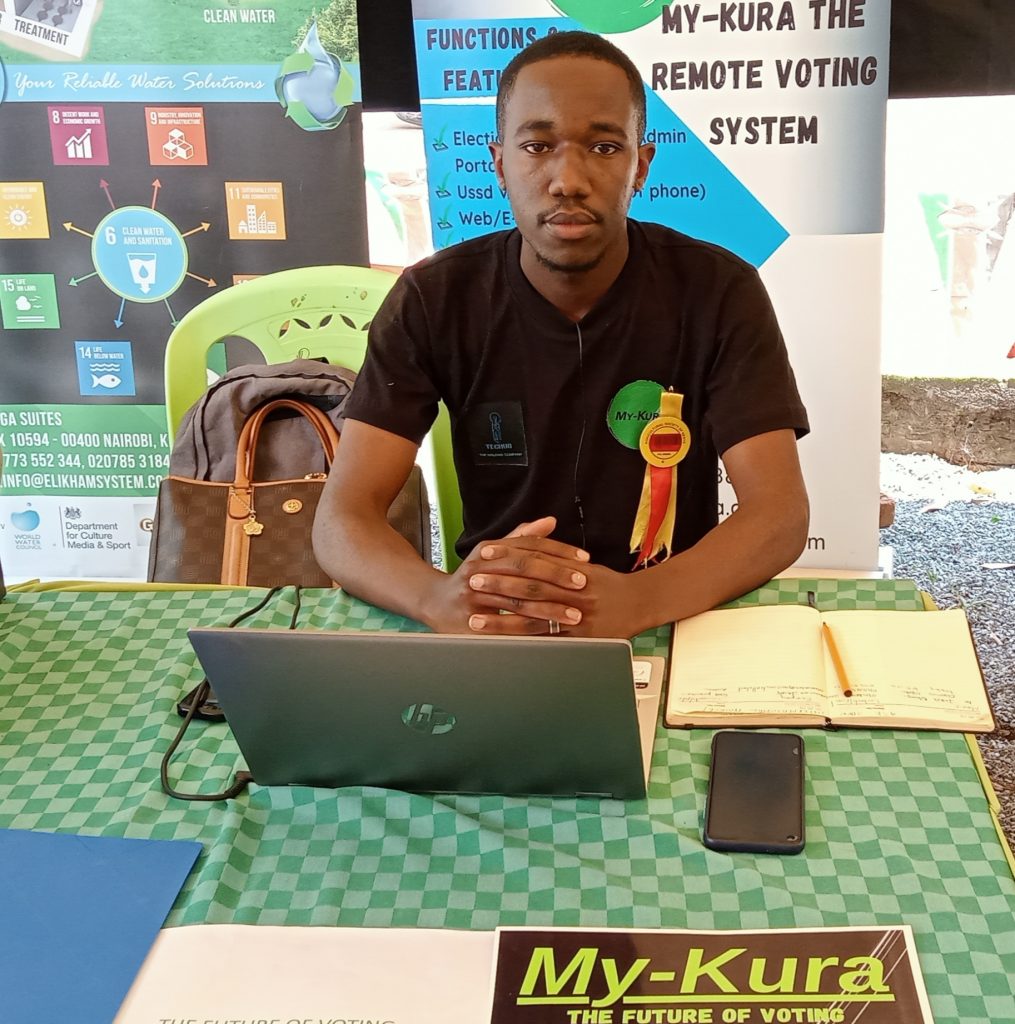
Nicholas Mugambi, CEO of Tech Hub and founder of My Kura. Photo by Tebby Otieno
Further Mr Mugambi believes that the technology would offer a solution to election rigging and save money spent on election petitions.
“For My Kura, let’s say for a national case, it will slash the budget by half. Even in terms of earning money, the state is always closed, with people anxiously awaiting elections. However, with My Kura, once you vote, it is reflected on the website, you receive a soft copy, and things move quickly,” he enthuses.
In an interview with this publication during the recently concluded Nairobi International Show, Mr Mugambi explained that just like the current voting system, anyone using My Kura and who qualifies for registration under Section 5 of the Elections Act will be required to register first. Registration will help the system determine who is eligible to vote on election day. Mr Mugambi added that My Kura will enable voters to use a dumbphone, smartphone, laptop, or other computing devices to vote for their leaders.
“We use USSD (Unstructured Supplementary Service Data) for kabambe (dumbphones) and web vote, which is through a proxy and also an app for smartphones. We have an app that allows you to access My Kura. You can also vote online using a computer,” notes Mr Mugambi adding that the app has complied with the Voter Verifiable Paper Audit Trail (VVPAT) that is aimed towards curbing rigging.
” That is to say, after casting a ballot, it informs the voter that the vote was cast, honestly and without the use of election fraud.” Says Mr Mugambi.
During his presentation, Mr Mugambi also explained that the technology can withhold the names of candidates a person has voted for and restrict this information to just the IEBC printing of the electronic copy, preventing even the voter from independently accessing such information after casting their ballot.
“When you register and dial the code or access it through the web or app it will bring the respective candidates and once you vote it gives you feedback through a soft ballot,” he explained.
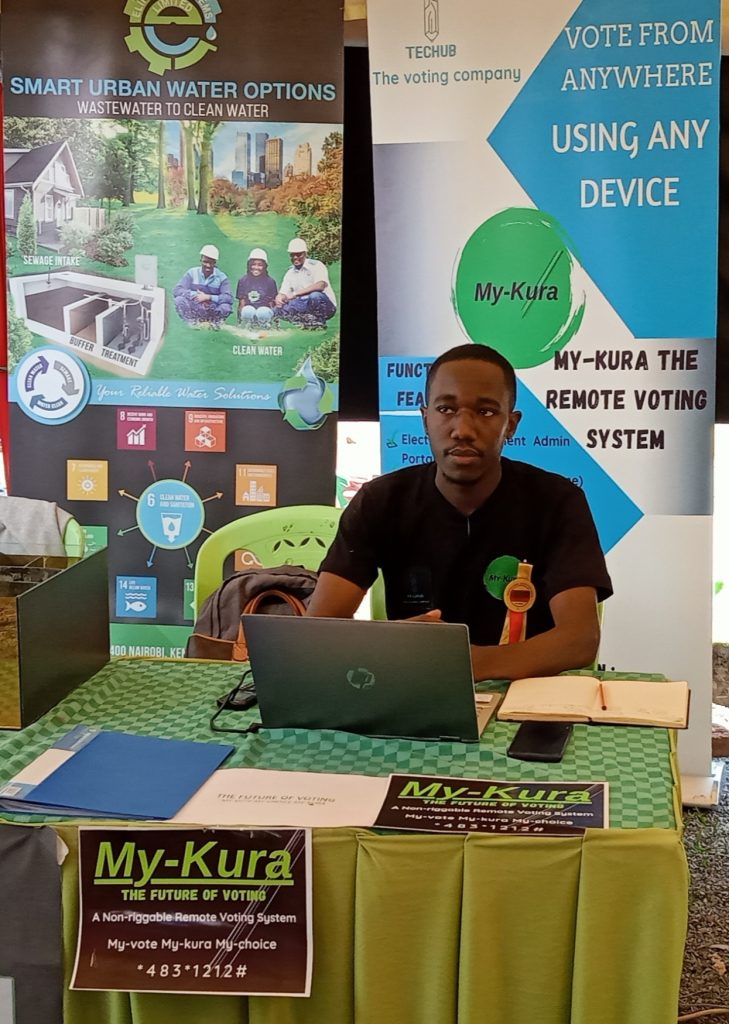
Nicholas Mugambi, CEO of Tech Hub and founder of My Kura. Photo by Tebby Otieno
Mr Mugambi came up with the idea of My Kura after witnessing the 2017 General Elections that saw the nullification of the presidential results at the supreme court. At the time, he was a student at Kangaru High School located in Embu county in the Eastern region of the country. Moreover, Mr Mugambi was concerned by the fact that schools have to be closed during elections as most schools in the country are used as polling centres.
“I began My Kura as an idea and a small proof of concept. I participated in the Science Congress for a high school competition, where we advanced to the national level, Bungoma county. After I passed my KCSE, I joined JKUAT, where I gained the technical skills necessary to program the system exactly as I imagined it,” he explains.
Mr Mugambi is confident that My Kura is ready to use in an election, especially because, as he explained, he and his Tech Hub team used it in the August poll where they did a dry-run. Moreover, according to him, the technology is currently being used by JKUAT, societies, and unions during various institutional elections.
“We have conducted elections for AGMs, we have delivered and disputed elections and also we are ready for piloting by IEBC to conduct maybe a by-election which we have proposed to the commission,” he says.
Before the technology can be approved for use by the Independent Electoral and Boundaries Commission (IEBC) in elections, it would require approval from Kenya’s parliament and Kenyans, especially because the constitution restricts the election system to a secret ballot. Nevertheless, Mr Mugambi expresses optimism that his innovation will be recognised.
“We hope that the government will hold our hands, fund this project, protect me as the innovator and also protect the innovation, My Kura,” he says.
Whether Kenya will accept My Kura technology as a voting method depends on factors such as trust and system security, which experts say will require Kenyan voters to believe their vote counts in an automated voting system. On the same note, they believe the method is inexpensive and improves transparency. Given the high cost of the election budget, governance experts believe that implementing an electronic system will reduce this cost.
The invention might also be beneficial to the environment. Speaking to the media during the August General Elections’ vote counting process at Nairobi’s Dagoretti North constituency, Nairobi County Woman Representative Esther Passaris urged the IEBC to adopt digital voting and counting in the future, noting that the current manual counting process was proving tiresome and was a danger to the environment.
“I wish we could go digital completely because all these long papers are trees that have been cut down to prepare them,” said Passaris.
Mr Mugambi’s invention might help lessen the number of trees cut down to print ballots now that discussions about climate change are taking over both national and international media platforms, a problem that environmentalists think should be solved.
Grab an exciting copy of Parents Magazine HERE
As the crescent moon appears in the night sky, marking the end of the ninth month of the Islamic lunar calendar, millions of people around the world transition from a period of deep reflection to one of vibrant celebration. Eid ul-Fitr, often called the “Festival of Breaking the Fast,” is one of the most significant dates in the calendar, representing a harmonious blend of spiritual accomplishment and communal joy.
Why is Eid al-Fitr celebrated?

Eid al-Fitr marks the conclusion of Ramadan, a month-long period where observers fast from dawn until sunset. The celebration is, at its core, a way to show gratitude. After thirty days of practising self-discipline, patience, and increased charity, the festival serves as a reward for the spiritual “marathon” completed during the holy month.
It is also a time to celebrate the revelation of the Quran, which is believed to have begun during the final ten days of Ramadan. By completing the fast, individuals celebrate the strength and willpower they gained, reinforcing their commitment to their values for the year ahead.
The importance of the day
Eid ul-Fitr is far more than just a day off from work or a festive meal; it serves several critical functions:
-
It acts as a bridge between the intense devotion of the previous month and a return to daily life, carrying forward the lessons of empathy and mindfulness.
-
The day begins with a special congregational prayer. This gathering brings together people from all walks of life, emphasising equality and unity within the community.
-
A key pillar of the holiday is Zakat al-Fitr, a mandatory charity given before Eid prayers. This ensures that everyone, regardless of their financial status, can enjoy a festive meal and join the celebration.
What does Eid al-Fitr mean?
While the literal translation is “the feast of breaking the fast,” the deeper meaning of Eid revolves around renewal.
-
Many view the day as an opportunity to start fresh. It is a traditional time for reconciling differences, forgiving past grievances, and strengthening bonds with family and neighbours.
-
After experiencing the hunger and thirst of a fast, the “Fitr” (breaking of the fast) takes on a profound meaning. It is a moment to appreciate the necessities of life (food, water, and health) that are often taken for granted.
- Beyond the religious context, it is a day defined by hospitality. Homes are opened, special sweets are shared, and children often receive gifts or Eid (money), creating a sense of wonder and belonging that lasts a lifetime.
Common traditions around the world
While customs vary by region, a few hallmarks remain constant:
-
Wearing new or best-quality clothes to honour the occasion.
-
In many cultures, the holiday is nicknamed the “Sweet Eid” due to the variety of desserts, like sheer khurma or baklava, served to guests.
-
The universal phrase used to wish others well is “Eid Mubarak,” which translates to “Have a blessed Eid.”
In essence, Eid al-Fitr is a beautiful reminder that discipline leads to joy, and that the greatest celebrations are those shared with others.
For more, click HERE to join our WhatsApp channel!
As the crescent moon appears in the night sky, marking the end of the ninth month of the Islamic lunar calendar, millions of people around the world transition from a period of deep reflection to one of vibrant celebration. Eid ul-Fitr, often called the “Festival of Breaking the Fast,” is one of the most significant dates in the calendar, representing a harmonious blend of spiritual accomplishment and communal joy.
Why is Eid al-Fitr celebrated?
Eid al-Fitr marks the conclusion of Ramadan, a month-long period where observers fast from dawn until sunset. The celebration is, at its core, a way to show gratitude. After thirty days of practising self-discipline, patience, and increased charity, the festival serves as a reward for the spiritual “marathon” completed during the holy month.
It is also a time to celebrate the revelation of the Quran, which is believed to have begun during the final ten days of Ramadan. By completing the fast, individuals celebrate the strength and willpower they gained, reinforcing their commitment to their values for the year ahead.
The importance of the day
Eid ul-Fitr is far more than just a day off from work or a festive meal; it serves several critical functions:
-
It acts as a bridge between the intense devotion of the previous month and a return to daily life, carrying forward the lessons of empathy and mindfulness.
-
The day begins with a special congregational prayer. This gathering brings together people from all walks of life, emphasising equality and unity within the community.
-
A key pillar of the holiday is Zakat al-Fitr, a mandatory charity given before Eid prayers. This ensures that everyone, regardless of their financial status, can enjoy a festive meal and join the celebration.
What does Eid al-Fitr mean?
While the literal translation is “the feast of breaking the fast,” the deeper meaning of Eid revolves around renewal.
-
Many view the day as an opportunity to start fresh. It is a traditional time for reconciling differences, forgiving past grievances, and strengthening bonds with family and neighbours.
-
After experiencing the hunger and thirst of a fast, the “Fitr” (breaking of the fast) takes on a profound meaning. It is a moment to appreciate the necessities of life (food, water, and health) that are often taken for granted.
- Beyond the religious context, it is a day defined by hospitality. Homes are opened, special sweets are shared, and children often receive gifts or Eid (money), creating a sense of wonder and belonging that lasts a lifetime.
Common traditions around the world
While customs vary by region, a few hallmarks remain constant:
-
Wearing new or best-quality clothes to honour the occasion.
-
In many cultures, the holiday is nicknamed the “Sweet Eid” due to the variety of desserts, like sheer khurma or baklava, served to guests.
-
The universal phrase used to wish others well is “Eid Mubarak,” which translates to “Have a blessed Eid.”
In essence, Eid al-Fitr is a beautiful reminder that discipline leads to joy, and that the greatest celebrations are those shared with others.
For more, click HERE to join our WhatsApp channel!

Hello world!
Teen, 17, Fatally Stabbed During Altercation with Friends in Eastleigh
Teen, 17, Fatally Stabbed During Altercation with Friends in Eastleigh
-

 Fashion9 years ago
These ’90s fashion trends are making a comeback in 2017
-
Entertainment9 years ago
The final 6 ‘Game of Thrones’ episodes might feel like a full season
-
Fashion9 years ago
According to Dior Couture, this taboo fashion accessory is back
-
Sports9 years ago
Phillies’ Aaron Altherr makes mind-boggling barehanded play
-
Entertainment9 years ago
The old and New Edition cast comes together to perform
-
Business9 years ago
Uber and Lyft are finally available in all of New York State
-
Entertainment9 years ago
Disney’s live-action Aladdin finally finds its stars
-
Sports9 years ago
Steph Curry finally got the contract he deserves from the Warriors